Tic tac toe rules
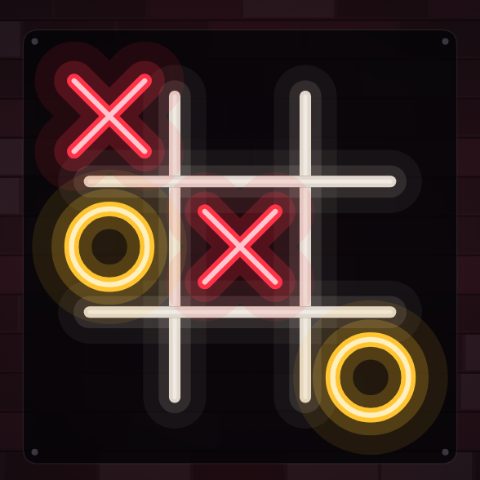
Tic tac toe is played on a 3 by 3 grid. One player is X, the other is O, and you take turns putting one mark in an empty square. The first to get three marks in a row, across, down or diagonally, wins. If all nine squares fill up and nobody has a line, the game is a draw.
On Arena13 you pick X or O before you play. You move first in your first match, then the first move swaps every match, so nobody keeps the advantage. Tap a square to play, or use the keys 1 to 9 on a keyboard: 1 is the top left square and 9 the bottom right.
Can you win tic tac toe? Is it always a draw?
Tic tac toe is a solved game. With best play from both sides, every game ends in a draw, and neither the first nor the second player can force a win. So you can't beat a player who never makes a mistake, but you can make sure you never lose, and you can win every time your opponent slips.
The best opening moves
The squares are not equal. The centre is part of four lines (the middle row, the middle column and both diagonals), each corner is part of three, and each edge square only two. That is why good players open in the centre or a corner.
- Going first: take the centre or a corner. A corner gives the other player more ways to go wrong, because only one reply is safe.
- Going second against a corner: take the centre. Every other reply loses against best play.
- Going second against the centre: take a corner. An edge reply lets the first player set up a fork.
Forks: how to win tic tac toe
A fork is a move that makes two threats at once: two lines that each need just one more mark. Your opponent can block only one of them, so you win with the other.
Here is a fork in action. X takes the top left corner and O answers on the top edge next to it. X takes the centre, which threatens the diagonal, so O has to block the bottom right corner. Now X plays the bottom left corner and has two threats at once: the left column and the other diagonal. O can't stop both.
How to block a fork
Defending means seeing the fork one move early. Before every move, ask two questions: can my opponent win next move, and can they make two threats next move? If the answer to the second question is yes, take that square yourself, or make a threat of your own so they have to answer you instead.
The classic trap: X holds two opposite corners and O holds the centre. If O now takes one of the other corners, X has to block, and that block is also a fork. The right reply is an edge square. It makes a threat that X must block, and the game heads for a draw.
Tic tac toe strategy in seven steps
On every turn, play the first move on this list that you can:
- Win: if you have two in a row and the third square is empty, take it.
- Block: if your opponent has two in a row, block it.
- Fork: make two threats at once.
- Block a fork: stop the square that would give your opponent two threats, ideally by making a threat of your own.
- Centre: take it if it is free.
- Opposite corner: if your opponent is in a corner, take the one across from it.
- Empty corner, then empty edge.
Follow that list and you will never lose a game of classic tic tac toe.
Your opponents on Arena13
Against the computer you pick one of three opponents. Your wins, losses and draws against each one are kept in your browser.
- Ash (Easy) always takes a win when there is one, but blocks your threats only about two times in three, and about half of its other moves are random.
- Rook (Medium) never misses a win or a block. About one move in four, though, it only looks two moves ahead, and that is when a fork can catch it.
- Queen (Hard) works out the whole game in Classic, so she never loses it. A draw is the best result against her, which makes her a good test of your defence.
Their comments are honest. A block comment only comes after you really had a winning square, and a fork comment only when the computer really has two ways to win.
Vanishing rules
Vanishing is the second rule set. Each player can only have three marks on the board. When you place a fourth, your oldest mark falls off the wall. When it is your turn and you already have three marks, the one that will go next flickers, so you always know which it is. Your oldest mark is removed before the game checks for a line, so a line can never use the mark that is about to fall. The board never fills up, so a game is only a draw if 60 moves pass without a line.
Strategy for Vanishing
- Build with your newest marks. Once you have three marks down, a two in a row that includes your oldest mark is not a threat: playing the third square removes the oldest first.
- Read your opponent the same way. A two in a row that uses their flickering mark is not a real threat on their next move.
- Blocks expire. The mark you used to block a line will fall a few moves later, and the threat can come back. Keep an eye on old blocks.
Queen is the toughest opponent here too. Vanishing games have no fixed end, so she searches as deep as she can in about half a second before each move.
Two players on one device
Choose 2 players to play a friend on the same phone or computer. X and O take turns, and you pass the device over after each move. X moves first in the first match, then the first move swaps every match. Classic and Vanishing both work, and the tally keeps the score for X, O and draws. When you want a bigger board with the same idea, try Four in a Row.