How does bowling scoring work?
A game of ten-pin bowling has ten frames. In each frame you get up to two balls to knock down all ten pins. Knock them all down with the first ball and the frame is over. A frame scores the pins knocked down, plus a bonus when you clear all ten. Those bonuses are why the top score is 300, not 100.
Open frames
If any pins are still standing after both balls, it is an open frame, and it scores exactly the pins you knocked down. A 7 and then a 2 scores 9. A ball that knocks nothing down is written as a dash, so 9 and then a miss is written 9 - and scores 9.
Strikes (X)
A strike is all ten pins with the first ball of a frame, marked X. A strike scores 10 plus the pins from your next two balls. Say you strike, then bowl a 3 and a 4 in the next frame. The strike frame scores 10 + 3 + 4 = 17, the next frame scores 7, and your total after two frames is 24. Until those two balls are bowled, the strike frame has no score yet.
Spares (/)
A spare is all ten pins with the two balls of a frame, for example a 6 and then the last 4. It is written as the first count and a slash: 6 /. A spare scores 10 plus the pins from your next ball. If the next frame is a 5 and a 2, the spare scores 10 + 5 = 15, the next frame scores 7, and the total is 22.
Strikes in a row
Two strikes followed by an 8 and a 1 score like this: the first strike is 10 + 10 + 8 = 28, the second is 10 + 8 + 1 = 19, and the open frame is 9. Two strikes in a row are called a double, and three in a row a turkey.
The tenth frame bonus balls
The tenth frame has no next frame to borrow from, so its bonus balls are bowled in the frame itself:
- Strike with the first ball: you get two more balls.
- Spare: you get one more ball.
- Open frame: no extra ball. The game is over.
The tenth frame simply adds up every ball bowled in it, so it can take three balls and score up to 30. A strike, an 8 and a 2, written X 8 /, scores 10 + 8 + 2 = 20.
What is a perfect game in bowling?
A perfect game is twelve strikes in a row: one in each of the first nine frames and three in the tenth. Every frame then scores 10 + 10 + 10 = 30, and ten frames of 30 make 300, the highest score possible in ten-pin bowling.
A full game, worked out
Here is one whole game: a strike, 7 and a spare, 9 and a miss, two strikes, 8 1, 6 and a spare, a strike, 7 2, and a strike, 8 and a spare in the tenth.
| Frame | Balls | Frame score | Total |
|---|---|---|---|
| 1 | X | 10 + 7 + 3 = 20 | 20 |
| 2 | 7 / | 10 + 9 = 19 | 39 |
| 3 | 9 - | 9 | 48 |
| 4 | X | 10 + 10 + 8 = 28 | 76 |
| 5 | X | 10 + 8 + 1 = 19 | 95 |
| 6 | 8 1 | 9 | 104 |
| 7 | 6 / | 10 + 10 = 20 | 124 |
| 8 | X | 10 + 7 + 2 = 19 | 143 |
| 9 | 7 2 | 9 | 152 |
| 10 | X 8 / | 10 + 8 + 2 = 20 | 172 |
The final score is 172. The bonuses reach forward: the strike in frame 4 counts the strike in frame 5 and the 8 from frame 6, and the spare in frame 7 counts the strike in frame 8.
Splits
A split is when the first ball knocks down the head pin and leaves standing pins with a gap between them, like the 7-10 in the two back corners. Splits are hard to pick up, and scoresheets often circle the count to show one.
How Lane Ten plays
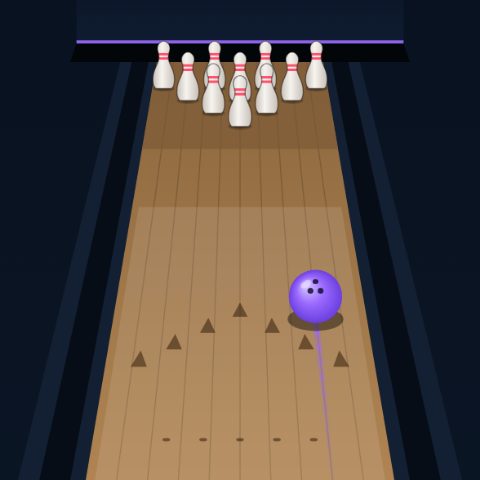
Lane Ten uses exactly the scoring above: ten frames, two balls a frame and bonus balls in the tenth. The frame strip across the top fills in X, / and - as you bowl, circles the count when a first ball leaves a split, and shows each running total as soon as that frame's bonus is known. After a first ball, the fallen pins are swept away and the standing ones are set back on their spots.
- Flick up the lane to bowl. The speed of the flick sets the speed of the ball, from gentle to fast. Only the end of the flick counts, so a pause before it does not slow the ball.
- Bend the flick to hook. The start of the flick sets the line, and if the flick curves, the ball hooks the same way. The hook bites late, on the dry end of the lane near the pins.
- Drag sideways, without flicking up, to move the ball along the foul line before you bowl.
- On a keyboard, the left and right arrows move the ball, A and D set a hook of up to three steps either way, and holding Space or Enter fills a power meter that rises and falls. Let go to bowl. The A and D hook is added to a flicked ball too.
After every ball the game calls it: strike, spare, split, gutter or the number of pins. The pins tip, bounce off the side walls and knock each other over. Each day brings a new numbered lane, the same for everyone, with its own drift shown on the start card: none, a slight push left or right, or a stronger one. Your best game and your best today stay in this browser, and your score can go on the leaderboard.
Tips for Lane Ten
- Read the drift first. The drift pushes the ball sideways all the way down the lane. A slow ball spends longer on the lane, so it drifts and hooks more than a fast one.
- Aim for the pocket, not the head pin. In bowling, a ball that hits the head pin full on often leaves pins standing on both sides. The pocket is the gap beside the head pin: start the ball off centre and let the hook bring it in at an angle.
- Change one thing at a time. Keep the start spot and flick the same and adjust only the line or the hook.
- Take the spare. An open 9 scores 9, a spare scores 10 plus your next ball, so the last pin or two is worth more than it looks.
Want more? Try the other free sports games on Arena13.