What is around the clock in darts?
Around the clock is a darts game where you hit the numbers on the board in order: 1, then 2, then 3, all the way to 20. You only move on once you have hit the number you are on. It works for any number of players, and it works just as well on your own, which is why it is one of the most popular darts practice games.
Around the clock darts rules
- Players take turns of three darts.
- Everyone starts on the 1. Any part of the 1 counts: the single, the double or the treble.
- As soon as you hit your number, aim for the next one, even with the next dart in the same turn.
- Darts in any other number do not count.
- The first player to hit the 20 wins, or the first to hit the bull after the 20 if you play with a bull finish.
Popular variants
Around the clock is played many ways, so agree on the house rules before the first dart. These are the common variants:
- Bull finish: after the 20, you must hit the bull to win. Some players accept the outer bull, others only the bullseye.
- Doubles only or trebles only: only the double ring, or only the treble ring, of each number counts. Much harder, and good practice for finishing a leg.
- Skipping ahead: a double moves you on two numbers and a treble three, so accurate darts get round faster.
- There and back: go from 1 to 20, then back down to 1.
Why players use it for practice
Most darts games pull you toward the 20 at the top of the board. Around the clock sends you to every segment, including the numbers on the sides and at the bottom, where the angle feels different. On your own, count how many darts it takes you to get round, then try to beat that number next time. It is a simple, honest measure of how your aim is going.
Dartboard basics
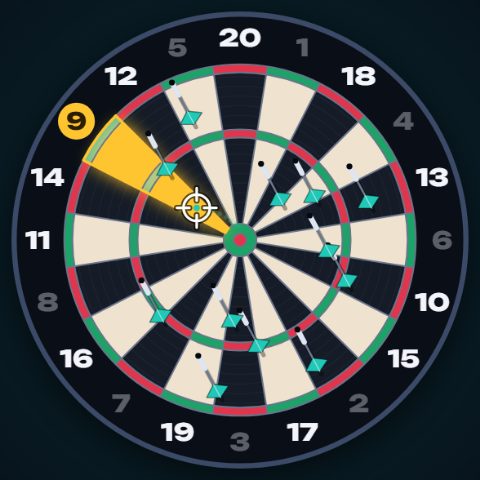
A standard board has 20 numbered segments. The 20 is at the top, and going clockwise the order is 20, 1, 18, 4, 13, 6, 10, 15, 2, 17, 3, 19, 7, 16, 8, 11, 14, 9, 12, 5. That order is what makes around the clock a real test: the 1 sits right beside the 20, but the 2 and the 3 are down at the bottom, and the 5 is back up beside the 20 on the other side.
- Single: the two big areas of each segment score the number.
- Treble ring: the thin inner ring scores three times the number.
- Double ring: the thin outer ring scores twice the number. A dart outside it, in the number ring, scores nothing.
- Outer bull: the green ring around the centre, 25 in standard darts.
- Inner bull, or bullseye: the red centre, 50 in standard darts.
How Dart Clock plays
Dart Clock is around the clock with a bull finish, on a board drawn to regulation proportions: hit 1 to 20 in order, then the bull. Instead of throwing with your arm, you time the throw. A crosshair wanders over the board around your target, and when you tap, the dart lands where the crosshair is at that instant, give or take a hair.
- Throw by tapping anywhere on the screen, or with Space or Enter on a keyboard.
- Your target glows gold on the board, and its number on the ring is circled.
- Any ring of the target counts: single, double or treble. A dart in another number, in the bull before you get there, or off the board is a miss.
- The bull counts in either ring at the end: the outer bull or the bullseye.
- The crosshair wanders wider with every number you clear. At the 20 its path is nearly six times as wide as at the 1. On the bull it traces a slowly turning figure-eight that always passes through the centre.
- A trail of dots behind the crosshair shows where it has just been, so you can see which way it is moving.
- Every miss is explained: the game says where the dart went, such as just left of the target, or how many millimetres wide of the bull.
How Dart Clock scores
You get 63 darts for the whole clock, three per target on average. Every throw uses a dart, hit or miss, and only hits on the target score:
- Single: 30 points
- Double: 50 points
- Treble: 70 points
- Outer bull: 50 points
- Bullseye: 70 points
Hitting the bull finishes the round. If the darts run out first, the round ends on the number you were chasing. Spare darts do not add points, so the best possible score is a treble on all twenty numbers and then the bullseye: 20 x 70 + 70 = 1470. Your best score and the furthest number you have reached stay in this browser, and your score can go on the leaderboard.
Tips for Dart Clock
- Take your time. There is no time limit on a throw, so waiting costs nothing. Watch the crosshair for a moment and throw as it heads into the target.
- Time the ring, not just the number. The crosshair moves more in and out along the target's wedge than side to side, so the ring you land in changes faster than the number. Throw as it crosses the inner thin ring for a treble.
- Chase trebles early. On the first numbers the wobble is small and its path runs across the treble ring, so 70-point darts are within reach. Later, when the path is wide, take the first clean pass through the segment.
- Read the trail. The dots show which way the crosshair is going, so you can throw just before it reaches the target instead of just after.
- Wait for the cross on the bull. The figure-eight always passes through the centre, so watch for that moment rather than throwing at a wide loop.
- Watch your darts. The darts counter turns red when you have 9 or fewer left.
Want more? Try the other free sports games on Arena13.