How does curling work?
Curling is a team sport played on a sheet of ice about 45 metres long. Players slide granite stones, up to 19.96 kg each, toward a target of rings called the house at the far end. The two teams take turns, one stone each. When every stone has stopped, the team with the stone nearest the centre scores. That round is called an end, and the team with more points after the last end wins.
The sheet: house, button, hog lines and back line
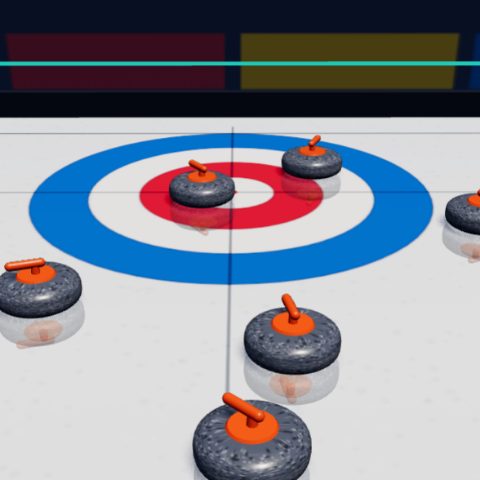
- The house is the target: the 12-foot, 8-foot and 4-foot rings, named for their diameters, and the button in the middle.
- The tee line runs across the sheet through the centre of the house. Its centre point is the tee.
- The back line runs across the back edge of the house. A stone that goes completely past it is out of play; a stone still touching it is in.
- The hog lines cross the sheet 6.4 metres (21 feet) in front of each tee line. A thrown stone must get completely past the far hog line, or it is removed, unless it hit another stone in play.
- The sides: a stone that touches the side line or side board is out of play.
Ends, stones and the hammer
In team curling each side has four players who throw two stones each, so a team throws eight stones per end. Championship games are usually 10 ends; many club games are 8.
The last stone of an end is called the hammer, and it is a big advantage, because no stone comes after it. The hammer for the first end is decided before the game. After that, the team that scores gives the hammer to the other team. If nobody scores, called a blank end, the hammer stays where it was.
How is curling scored?
Only one team scores in an end. Find the stone nearest the tee: its team scores one point for every stone of theirs that is nearer the tee than the other team's nearest stone. A stone only counts if it is in the house, which means any part of it touches the outer ring. If your two nearest stones both beat the opponent's best, you score 2. Scoring without the hammer is called a steal.
The free guard zone
A stone that stops between the hog line and the tee line, outside the house, is a guard, and that area is the free guard zone. Early in an end, an opponent's stone in the zone may be moved but not knocked out of play. Under World Curling's five-rock rule, that protection lasts until the sixth stone of the end. If a protected stone is removed too early, the thrown stone is taken off and the other stones are put back.
Curl, the turn and sweeping
A curler releases the stone with a slow spin, called the turn. A stone turning clockwise curls to the right, and one turning counterclockwise curls to the left. The bend grows as the stone slows down, so most of the curl comes near the end of its path. Players aim to one side and let the ice bring the stone in, even around a guard.
The ice is covered in pebble, tiny frozen droplets sprayed on before play. Sweeping in front of a moving stone warms and smooths the pebble for a moment, so the stone travels further and curls less.
How to play curling in Stone Slide
Stone Slide is a 3D curling game that plays by the rules above, hog line, side boards and back line included. The controls:
- Throw: drag up anywhere and let go. A longer drag throws harder. A ring around the stone shows the weight in percent, and a word beside it says where the throw would stop on open ice, such as Guard, Into the house or Through the house.
- Turn: the turn button under the ice reads Curls right or Curls left. Tap it before you throw to switch.
- Sweep: tap fast while your stone runs. Each tap sweeps for about a third of a second, so keep tapping.
- Keyboard: the arrow keys aim and set the weight, T switches the turn, and Space throws and sweeps.
Daily solo: eight stones
Daily solo gives everyone the same ice for the day, with a light, medium or strong curl. You throw eight stones, and when the last one stops each stone scores by where its centre lies: 10 on the button, 7 in the 4-foot ring, 4 in the 8-foot ring and 2 in the 12-foot ring. If any stone covers the very centre of the button, you get 20 more. Hogged and out stones score nothing, and a later stone can knock an earlier one in or out, so the sheet at the top shows each stone's points as it lies now. The daily solo goes on the leaderboard.
Match vs the computer
Match mode is four ends of four stones per side, with the hammer and real curling counting. The hammer for the first end is picked at random, the side without it throws first, and the side that scores gives it up. With only four stones each, Stone Slide uses a four-rock free guard zone: before the fifth stone of an end, the other side's guard can't be knocked out of play. If it is tied after four ends, up to two extra ends are played and the next score wins; still level, it is a draw. Matches never go on the leaderboard.
Opponent levels: Casual misses its line and weight the most and only sometimes tries to knock out your shot stone. Club is steadier and usually goes for the takeout. Strong is the most accurate, always tries the takeout when the path is open, and likes a centre guard to open an end without the hammer.
Stone Slide tips
- Aim against the turn. If the stone curls right, aim a little left and let the ice bend it in.
- Use guards. A stone parked just short of the house scores nothing in solo, but a later stone can bump it onto the button.
- Mind your own stones. The same line and weight will hit the stone you just placed. Aim a touch to the side and it slips past.
- Hit stones run straight. A stone knocked by another doesn't curl, so it travels along the line it was struck.
- With the hammer, play for two. If only one point is on offer, a blank end keeps the hammer for the next end.