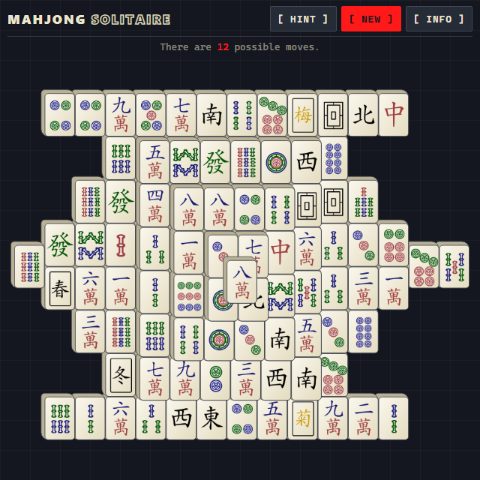
What is mahjong solitaire?
Mahjong solitaire is a one-player tile matching puzzle that uses the tiles of mahjong. It is a different game from four-player mahjong, where players draw and discard tiles to build winning hands. In the solitaire version all the tiles are stacked face up on the table, and you remove them two at a time until the table is empty.
The 144 tiles
A full set has 144 tiles in seven groups:
- Three suits: dots, bamboo and characters, numbered 1 to 9, with four of each tile. That is 108 tiles.
- Winds: four different winds, four of each, 16 tiles.
- Dragons: three different dragons, four of each, 12 tiles.
- Flowers and seasons: four flowers and four seasons, one of each, 8 tiles.
The turtle layout
Arena13's Mahjong Solitaire uses the classic turtle layout. The tiles stand in five layers: a wide bottom layer of 87 tiles, then a 6 by 6 layer of 36, a 4 by 4 layer of 16, a 2 by 2 layer of 4 and a single tile on top. The rows of the bottom layer have different lengths, and three tiles stick out from the middle of the board: one on the left end and two in a row on the right end.
Mahjong solitaire rules
- Remove tiles in matching pairs. Pick one tile, then its partner, and both leave the board.
- Only free tiles can be picked. A tile is free when nothing lies on top of it and at least one of its sides, left or right, is open. Tiles in the rows above and below it on the board don't block it; only its left and right neighbours do.
- Identical tiles match. A 5 of bamboo goes with a 5 of bamboo, and each wind or dragon goes with the same wind or dragon.
- Flowers match any flower and seasons match any season. Each of them appears only once, so any two flowers make a pair, and so do any two seasons.
- You win when all 144 tiles are gone. If tiles are left but no two free tiles match, you are stuck and the game is over.
Two places in the turtle need a closer look. The single top tile sits over the middle of the 2 by 2 layer, so all four of those tiles are blocked until it is gone. And the tiles sticking out at the ends close off the two long middle rows: the left end tile blocks the left side of both rows, and the inner right end tile blocks their right side.
How to play on Arena13
Tap or click a free tile to select it, then tap its match to remove the pair. Tap the selected tile again to let go of it, or tap a different free tile to select that one instead. Tiles that are not free don't react.
The status line above the board counts the possible moves after every pair, for example "There are 6 possible moves." When it says there is exactly one possible move, slow down and look twice. The buttons at the top do the rest: Hint flashes one tile of a possible pair and selects it, so you only have to find its partner; New deals a fresh game; Info shows the rules. There is no undo and no reshuffle. When no moves are left the game ends with "No moves left", and New game deals again.
Why boards get stuck
The tiles are shuffled at random for every game, and the game does not check that a deal can be cleared, so it pays to think before each pair. Most stuck boards come from one of these:
- Stacked partners. If the last two tiles of a kind sit one on top of the other, the upper one can never be matched, because its only partner is underneath it.
- The wrong two of three. When three tiles of a kind are free, the pair you take decides where the last one stays. Take the wrong two and the fourth tile may stay buried.
- Pairs taken just because they were easy. A pair at the edge of the board that frees nothing can be saved for later, when its tiles might be needed to unlock something else.
Mahjong solitaire strategy
- Open the ends early. The end tiles hold the two long middle rows closed. Clearing them opens the rows from the outside.
- Work from the top down. The top tile blocks four tiles, and every upper layer covers tiles below it. Clearing the upper layers opens far more of the board than picking at the bottom edges.
- Prefer pairs that free something. Before each match, ask which new tiles it will free. A pair that unlocks two or three tiles is worth more than one that unlocks none.
- Take all four when you can. When all four tiles of a kind are free, remove both pairs. Nothing else can need them.
- With three free, think about the fourth. If the fourth tile is buried under one of the three, use the one on top of it so the fourth comes free.
- Split stacked partners early. When you spot two matching tiles on top of each other, match the upper one with another partner while you still can.
- Watch the move counter. If the number of possible moves keeps falling, work on the tiles that block the most before taking easy pairs.
- Use Hint to check, not to play. It only shows a move that exists, which is useful when you can't find one, but it doesn't pick the best move.