Spades in one minute
Four players each get 13 cards and bid how many tricks they expect to win. Spades are always trump. Take at least the tricks you bid and you score; fall short and you lose points. The first side to reach the target score wins.
Players and partners
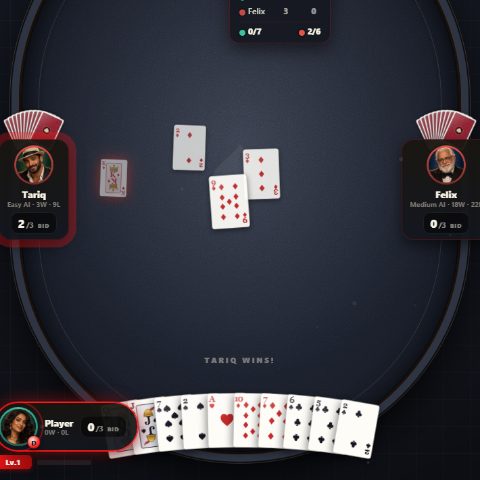
On Arena13 you play Spades against three computer players. In the default 2v2 Teams mode, the player sitting across from you is your partner, and the players on your left and right are a team against you. In Cutthroat mode every player is on their own and keeps a separate score and a separate bag count.
The deal
A standard 52-card deck is shuffled and dealt out, 13 cards each. Cards rank from ace (high) down to 2 in every suit. After each hand the deal moves one seat to the left.
How to bid in Spades
Bidding starts with the player to the dealer's left and goes once around the table. Each player bids a number of tricks from 1 to 13, or Nil. A bid is final once it is made. In teams mode your bid and your partner's bid add up to your side's contract: if you bid 3 and your partner bids 4, your team needs 7 tricks between you.
To count your tricks, look for cards that should win on their own: aces, kings with one or two smaller cards of the same suit to protect them, and high spades. When it is your turn, the game shows a suggested bid worked out from your hand, which is a good guide while you learn.
Nil and Blind Nil
Bidding Nil is a promise to take no tricks at all. Take none and you score 100 points; take even one and you lose 100. In teams mode, a Nil is scored on its own: your partner's bid is still their contract, and tricks you win while on Nil do not count toward it.
Blind Nil is the same promise made before you look at your cards, and it is worth 200 points either way. On Arena13 it is offered only in teams mode, and only when your team is behind by 100 points or more. Say no and your cards are shown, and you bid as normal.
Playing the tricks
The player to the dealer's left leads the first trick, and play goes around to the left. You must follow suit: if you hold a card of the suit that was led, you have to play one. If you don't, you may play any card, including a spade.
The highest spade in the trick wins it. If no spade was played, the highest card of the suit that was led wins. Whoever wins a trick leads the next one, until all 13 tricks are played.
Breaking spades
You can't lead a spade until spades are broken, which happens the first time anyone plays a spade, usually because they couldn't follow suit. The one exception: if your hand has nothing but spades left, you may lead one. Arena13 enforces this, and cards you are not allowed to play are dimmed.
Spades scoring
- Making your bid. If your side takes at least as many tricks as it bid, it scores 10 points per trick bid, plus 1 point for every extra trick. Bid 7 and take 9: 72 points.
- Getting set. If your side takes fewer tricks than it bid, it loses 10 points per trick bid. Bid 6 and take 5: minus 60.
- Nil. Plus or minus 100, scored on its own. Blind Nil is plus or minus 200.
Bags and the bag penalty
Every trick over your bid is a bag, also called an overtrick. A bag is worth 1 point, but bags add up from hand to hand, and every time your side reaches 10 bags it loses 100 points and the count carries on from what is left. With 8 bags, a hand with 3 more costs you 100 points and leaves you on 1 bag. Tricks won by a player who bid Nil also count as bags for their side. Bag penalties vary between tables; on Arena13 it is 100 points for every 10 bags.
How you win
Before the game you pick the target: 300, 500 (the default), 750 or a custom score from 100 to 1000. The game ends after the hand in which a side reaches it, and the highest score wins. If two sides are tied for the lead, another hand is played. With the default house rules, a side that falls to minus 200 also ends the game, and again the highest score wins.
House rules you can switch
- Nil and Blind Nil can each be turned off. Blind Nil needs Nil.
- Board of 4 (teams only): partners must bid at least 4 tricks between them. The second partner to bid has to bring the total up to 4, and may only bid Nil if the first partner already bid 4 or more.
- Jokers and Deuces: the 2 of clubs and 2 of hearts leave the deck and two jokers come in. Trump runs Big Joker, Little Joker, 2 of diamonds, 2 of spades, then ace of spades and down. The 2 of diamonds plays as a spade.
- Losing floor: minus 200, minus 500 or none.
Spades strategy
- Bid what you can win, not what you hope to win. Getting set costs the whole bid, while an extra trick earns just 1 point.
- Watch the bags. Once your contract is safe, play low and let the other side take tricks. Near 10 bags, one extra trick can cost 100 points.
- Try to set them. When the other side bids high, hold your winners for the tricks they need most.
- Cover a partner on Nil. Play your high cards to win the tricks your partner might be forced to take.
- Break a Nil. Against a Nil bidder, lead low cards. A player holding only higher cards in that suit has to win the trick.
- Count the spades. Keep track of the ones played, and your small spades become winners late in the hand.
Controls on Arena13
Tap a number to bid and tap a card to play it. On a keyboard, keys 1 to 9 pick one of the cards you can play, M opens the menu, R shows the rules and L shows the last trick. Win the match and you can post your side's final score to the leaderboard. Next, try the Klondike Solitaire rules.