Minesweeper rules in one minute
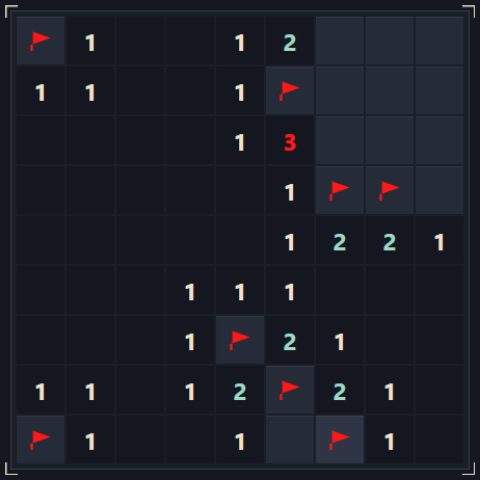
The board is a grid of hidden squares, and some of them hide mines. Your goal is to open every square that is not a mine. Open a mine and the round is over; open every safe square and you win.
When you open a safe square, it shows a number, or nothing at all. A blank square has no mines around it, so the game opens its neighbours for you, which is why one tap can clear a whole area. On Arena13 your first tap is always safe and always opens an area, so you can start anywhere.
What do the numbers mean in Minesweeper?
A number tells you how many mines touch that square. Every square has up to eight neighbours: left, right, up, down and the four diagonals. A 1 means exactly one of those neighbours is a mine. A 3 means three of them are. The number never counts the square itself, and it counts diagonal squares just like the others.
That gives you the two rules behind every Minesweeper strategy:
- If a number equals the hidden squares around it, they are all mines. A 2 with exactly two hidden neighbours: flag both.
- If a number already has that many flags around it, every other neighbour is safe. A 1 that touches a flag: open all its other hidden neighbours.
Flagging mines
Once you know where a mine is, flag it so you don't open it by accident and so the numbers around it get easier to read. On a phone, long-press a square or tap the Mode button to switch to Flag mode. On a computer, right-click a square, or press F to switch modes. The counter at the top shows how many mines are left unflagged.
Opening squares fast
When a number has all its mines flagged, tap the number itself. Every other hidden square around it opens in one go. This is the biggest time saver in the game, and since your score depends on time, it is worth learning early. Only do it when you are sure the flags are right: a wrong flag means a mine opens.
Minesweeper patterns that solve themselves
Experienced players don't count every square. They recognise a handful of patterns along the edge of the open area. These are the common Minesweeper patterns worth learning first:
- 1-1 from a wall. Two 1s side by side along a straight edge, with the first one against the side of the board: the square beyond the second 1 is safe. The first 1 can only see two hidden squares, and the second 1 shares both of them, so its mine is already used up.
- 1-2-1. Three numbers in a row along a straight edge: the mines are opposite the two 1s, and the square opposite the 2 is safe.
- 1-2-2-1. Four numbers in a row along a straight edge: the mines are opposite the two 2s, and the squares opposite the 1s are safe.
- A 2 on a straight edge with one known mine. If one of its mines is flagged and only one other hidden square is left, that square is the second mine.
Patterns work by subtraction: if one number's hidden squares are a subset of its neighbour's, the difference between the two numbers tells you about the squares only the bigger one can see. Once that idea clicks, you will start finding patterns of your own.
Minesweeper strategy when you are stuck
Sometimes the numbers really do not decide it, often near the end or in a corner. Before you guess, check the whole edge of the open area once more: a safe square somewhere else may open new numbers. If you must guess, pick the square with the best odds. Count the mines left on the counter and the hidden squares left; a square that touches no numbers at all is often safer than one next to a high number.
Minesweeper tips for beginners
- Start on Easy (9 by 9, 10 mines) until the patterns feel natural, then try Medium (12 by 16, 30 mines) and Hard (16 by 20, 60 mines).
- Work along one edge at a time instead of jumping around the board.
- Flag only what you are sure of. A wrong flag is worse than no flag.
- Speed comes from patterns and from tapping numbers to open their neighbours, not from tapping faster.
How scoring works on Arena13
A cleared board scores 1000 points on Easy, 3000 on Medium and 6000 on Hard, minus 5 points for every second it took. Hitting a mine scores nothing. Post your score under a nickname to get on the daily and all-time leaderboards.