Almost everyone has played snake: steer a line around the screen, eat, grow longer, and do not hit the walls or your own tail. The game is older than most people think, and its history runs from a two-player arcade cabinet in 1976 to a phone in nearly every pocket. Here is how it got from there to here.
1976: Blockade, the first one
The first snake game was an arcade game called Blockade, published by Gremlin Industries in 1976 and written by Lane Hauck and Ago Kiss. It was not quite the game we know: there was no food. Two players each steered a line that left a trail behind it, and the trails became walls. Whoever avoided crashing for longest won. The idea that your own path becomes the obstacle was there from the start.
1978 to the 1980s: home computers
Snake moved home quickly. In 1978 Peter Trefonas programmed Worm for the TRS-80, the first known home computer version, published by the magazine CLOAD. Versions appeared on the Commodore PET and the Apple II, and in 1982 Snake Byte brought it to Atari 8-bit computers and others. The same year, the arcade game Nibbler squeezed the snake into a maze and sped it up. In 1992 Rattler Race, part of Microsoft's second Entertainment Pack, added enemy snakes to the apple-eating.
1998: the phone in your pocket
The version most people remember came from Nokia. Taneli Armanto, part of a Nokia interface design team, programmed Snake for the Nokia 6110 and 5110 phones, released in 1998. Nokia's marketing team wanted the phone to give people more to do; Armanto first tried a falling-blocks game, could not get the rights, and turned to snake, a game he knew from older computers. He has said he "respectfully borrowed" ideas from earlier versions.
It worked. Nokia kept making sequels without him, starting with Snake II on the Nokia 7110, through a final version in 2007. According to Nokia, some 350 million copies of the game exist in one form or another, and Armanto thinks the real number is higher. In 2012 the Museum of Modern Art in New York announced Snake as one of the video games it would add to its collection.
2016: the snake goes online
In 2016 Steve Howse released Slither.io, a browser game where hundreds of players' snakes share one huge arena, and the snake that crashes into another becomes food for everyone else. It started a wave of online snake games, and brought the idea full circle: like Blockade forty years earlier, the danger was other players' trails.
Why it still works
Snake has survived for half a century because the rule is one sentence long and the difficulty comes from you. The better you play, the longer the snake gets, and the less room you leave yourself. Every game ends the same way, with you trapped by your own success.
Play it here
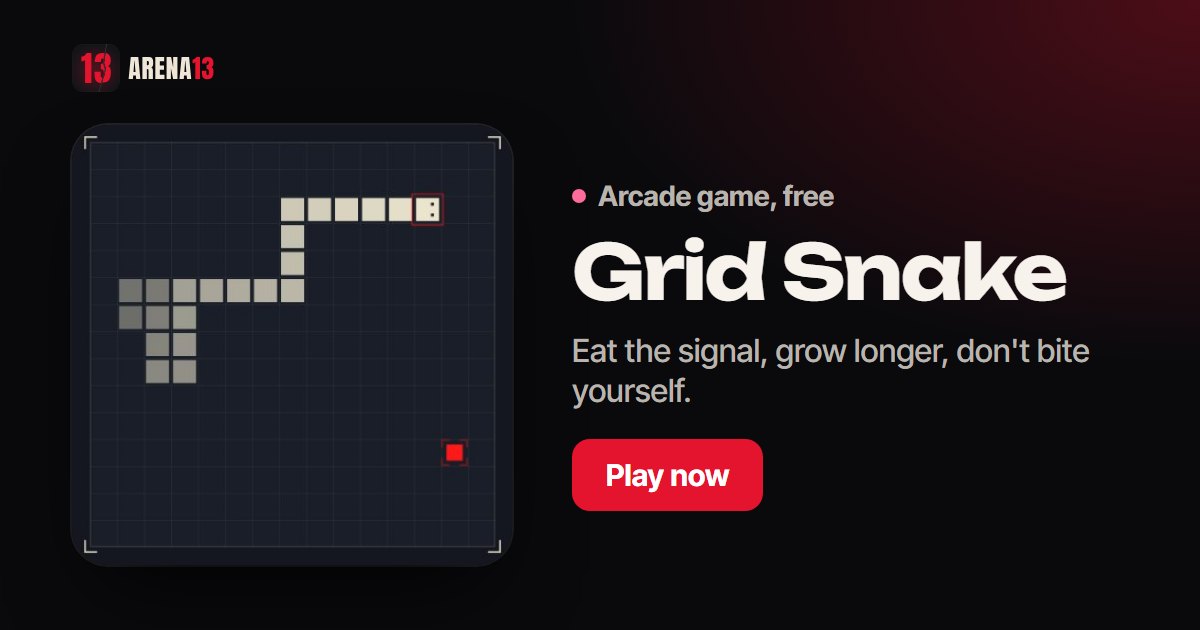
Grid Snake is the classic version on Arena13, sized to your screen. You start with three segments, every piece of food adds one and a point, and the snake speeds up as you eat: each step starts at 150 milliseconds and gets faster until it reaches its top speed at 32 points. The walls are solid, with no wrapping around. Swipe or use the on-screen pad on a phone, or the arrow keys on a computer; up to three turns queue up, so quick zigzags work. Space or Enter pauses, and the game pauses itself if you switch tabs.
A tip from the history: the long-snake strategy that wins is the boring one. Sweep the board in rows, leave yourself an exit, and do not chase food into a corner.
How it was made
I wrote this with help from Claude, an AI assistant, and checked the history against the sources below and the Grid Snake rules against the game's code. If you know an earlier snake game, tell me.
Sources
- Wikipedia, Snake (video game genre) and Snake (1998 video game), with their sources
- It's Nice That, Taneli Armanto on the history of Snake
- Windows Blog, Snake charmed: 10 facts about the world's most popular game, 2012